
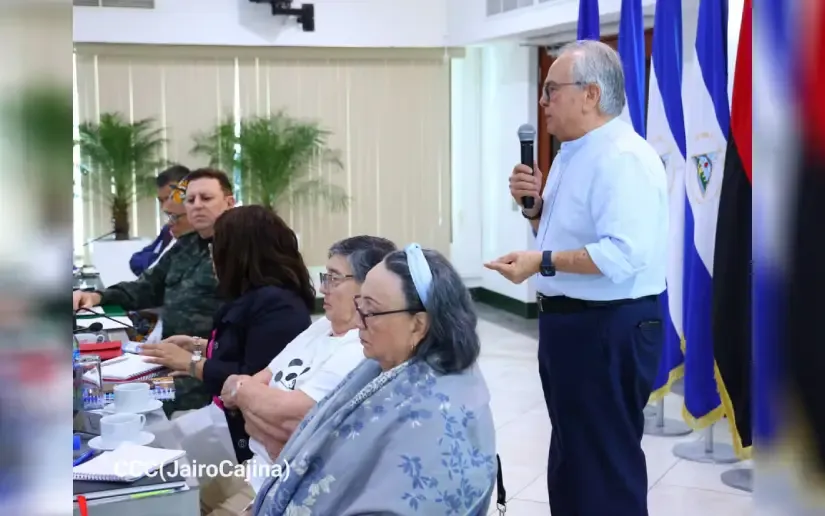
Explanation of the Proposal of the Constitutional Reforms
presented by Dr. Gustavo Porras,
President of the National Assembly,
to the Military Forces of the Nicaraguan Army
Wednesday, July 29th 2026
Good morning, friends and colleagues.
It is really gratifying for us to have you here in the National Assembly and at an important moment, in a Constitutional Reform process where the first consultation we are holding is with our military forces of the Nicaraguan Army, present here, with all the compañeros of your High Command.
And we would like to welcome General Julio César Avilés, Commander-in-Chief of the military forces of the Army of Nicaragua. General, this is your Assembly and we are at your disposal, because this is a People, an Army, in Unity: the Guarantee of Victory, that’s it.
Before starting the presentation, I want to explain to you that here present are our Fellow Members of the Executive Board of the National Assembly and that we are part of the Special Constitutional Commission. There are also the heads of political groupings, the three heads of the political groupings that exist in the National Assembly: the Sandinista Front, the PLC and the IDB, which unites several liberal parties; it is the Democratic Independent Grouping. They are also part of the Special Constitutional Commission, which is working on this issue.
There are also two committee chairpersons, who are participating. Compañero Wálmaro Gutiérrez, who is the president of the Committee for Production, Economy and the Budget Committee, and Compañera María Auxiliadora Martínez, who is the president of the Justice Committee. That is the composition of the Special Constitutional Commission.
Our mission, as you will have heard, is to fulfill the mandate, with the guidance of Comandante Daniel and Compañera Rosario, the Presidency of the Republic, with the mandate of these Co-Presidents, to carry out Reforms to guarantee our Stability, Security and Peace.
And you will have heard, to get straight into the matter now, you listened as we all listened, to the speech of Comandante Daniel on the 19th, and the speech, in many ways, really synthesizes the history of our country. It is true, we have been fighting against interference, meddling and undue influence, expressed in different ways. And one of those expressions, which often does not come on its own, is the manipulation of electoral processes.
I remembered that Comandante Daniel himself always recalls this as well: how, in some years, in the middle or a little before the middle of the last century, in the 1930s, elections were held here where the US Marines high command was installed as the Supreme Electoral Council and where the presidents of polling stations were the supervising officers of the Yankee navy, but that’s only one kind of meddling.
There was another way. Most of us present here can remember how there was a Yankee ambassador who was accompanied by election candidates, obviously candidates opposed to the Sandinista Front, because, in the end, that is the idea of any intervention, namely to go against everything that upholds Sovereignty and Self-Determination. So then they would go around with food packages doing political proselytizing.
But I also noted recently that one of the greatest displays of interference and intervention was that of 1990. It was an election organized by the Sandinista Government, by the Revolution, with all rigor and with all transparency. But those elections were not free, because in that case they put a gun to our head and said, “If the Sandinistas win, the war will continue.”
And it is self-evident, that this inclined a decision of the Nicaraguan people who, with intelligence, chose to seek an end to the war. And, as part of the People, Comandante Daniel, the leadership of the Sandinista Front, Compañeras and Compañeros, and, above all, Comandante Daniel’s position was: we must listen to the People, we must hand over the government in 1990. Because that was an absolutely wise and democratic decision, although we know that it was a vote made under the conditions of the time.
And I remember, as if it were today, I have always said so, when he said: «We are going to return to government by way of elections.” However, of course, as our society was structured, as the State was structured, that gave the Sandinistas and its government every possibility to to stand fast, and voices came out saying that we should ignore that vote.
Comandante Daniel, very wisely, said, «No.» I also remember that he said: «But we are going to govern from below”» referring to the popular struggle that had to be undertaken, in the streets and the popular resistance struggle that had to be undertaken.
I offer this context because, all of a sudden, they talk to us about Democracy, but they talk to us about Democracy referring to all the things they criticize us for. They call our Democracy, our Nicaraguan Democracy, the Democracy of all of us, a dictatorship, with the pejorative meaning of dictatorship, using the negative meaning they choose to give it.
This is our Democracy. In Nicaragua we decide, in Nicaragua we are going to make our own laws, in correspondence with the interests of the Nicaraguan people. And that’s what we’re doing since that’s what Comandante Daniel ordered us to do. He said “There will be no more elections that allow them to cheat their way to government, to steal their way to power.» And that’s what we’re going to do; we have to put up a wall, a barrier, to the coup promoting sectors and those sectors with the intention of promoting a coup.
And he also told us that we need Stability, Security and Peace of sufficient duration so as to carry out the objectives of economic construction and the objectives to win through in the central struggle which all Nicaraguans have, which is the fight against Poverty, that is the central struggle. As long as our country fails to overcome poverty, we are vulnerable, we will remain subject to a great deal of pressure. So we need to work in that direction. That’s what the Comandante tells us and that’s what we’re going to do.
So I’m going to present you with seven slides, that is, seven images. One may have only three or four lines, but they are the main concepts; that’s why it says there: Concepts. Of course, that is going to be transformed later in the reform process into the relevant shape, with all the vocabulary which lawyers are familiar with, but these are the concepts.
The first element of this Reform is this one. It is the one referred to in Article 47. Article 47 of the Constitution refers to the political rights of Nicaraguan citizens. And, of course, this has more words, but, for the purpose of the presentation, in essence what it says is… The essence of Article 47 is the first paragraph: «Citizens have the right to elect and be elected and to run for public office, except for the limitations provided for in this Political Constitution.”
But, by modifying it, this Reform adds this: “Coup plotters may not be candidates for popularly elected positions nor may they hold public office by appointment of the Presidency of the Republic or election of the National Assembly.» The phrase coup plotters means everyone who finances, who has participated, the whole range of activities, but as coup plotters, those cannot be allowed. «Those who commit or have committed acts that undermine the Independence, Sovereignty and Self-determination of Nicaragua.»
And there it all gets laid out, there you are going to see it for yourselves, because I understand that we are going to hand you the document that has the complete material. Here is a list of things that threaten, that undermine the Independence, Sovereignty and Self-determination of Nicaragua. All those who ask for military intervention; all those who try to undermine our country’s military forces; all those who spend their lives calling for economic blockades; all those who call, applaud and request sanctions against all of us, applaud the sanctions against all of us: we Citizens, our Institutions and the Country. That is to say, in this second point, the whole range of these demons’ expressions is set out.
Third: traitors to the Patriotic Nation, those cannot be allowed; so let it be in the Constitution. In this country, anyone who is considered a traitor to the Patriotic Nation loses their political rights. And such individuals have been coming out recently, and many of them are already posing, running as candidates in their minds. We have seen this on their social networks. And, finally, those who violate or have violated the fundamental principles laid out in this Political Constitution.
All this is Past and Present. That is to say, all this is for those who have participated or who, all of a sudden, do so at this moment; it is for those who commit violations or have already committed violations. And since there is due process whereby a judge, in the end, determines whether, with all the actions you committed, you are a traitor to our Patriotic Nation, that includes not only those who left on that plane flight, but anyone, at any time, at any given moment, then you lose all your Rights, but we make it clear, all political rights, fundamentally. So, this set out here as the first concept of the Reform.
The second concept has to do with time, with duration. Because, in fact, when we talk about Stability, Security and Peace, Stability is achieved by a period where you can settle down, above all, in models like ours, which is one of the People President, you have to work according to the transformation that we need and which the People feel is indeed taking place.
One might ask, why? Well, because every time you go to do something and you think about your superior, then you want to do it well, and the superior of us all is the People of Nicaragua. That’s why the Comandante, the Compañera, the Sandinista Front, we all say: the People President. And that is why we say that the People President is not a slogan, it is the expression of the social structure of Nicaragua.
That is what we intend, that this concept of the People President be structured. And, if you have noticed, we have developed a process of transformation even in our language. The word charity comes from our language, as well as the word beneficiary, which has entered our language, the word Protagonist has to be empowered so that it becomes not just a word, and that has to be done little by little. The People of Nicaragua are the Protagonists of their history.
Besides, this is not new to the Sandinista Front. That the People of Nicaragua are the Protagonists of their History, that is a concept that here we take for granted. So, we need the periods of government to be more stable.
It might well be that, from our point of view, the periods should be even more stable than this, but, after all, we are in the middle of an international controversy that has to be set to one side. So, we set out to review, with the mandate of the Comandante, of the Compañera, and the proposal or the guidance is for seven years. Those seven years signify a period no one can question.
And we began to review the panorama around the world. China uses ten years, but, Ireland, Italy use seven years; a lot of countries use seven years. This is not for the sake of copying or some such thing, but simply because we have to prepare for when people start asking «Why seven years?”.
First, because it is our right; above all, because it is our decision. We believe that it is a sufficient period to make progress on national projects, but, besides, we are not acting out of order. And that’s why I noted to the diplomats: there are other countries who have five; there are some who had five, until recently, and they went to six, like El Salvador. There are others… Well, we had already made that change from five to six, but there are others who have four, but four plus four, eight. Elsewhere I was reading that can even be four by four, sixteen.
But the important point here is it is up to us, our decision and the approach that we have and that we propose in this Consultation Process of explaining and listening, is that the period established in the Political Constitution of the Republic of Nicaragua for the positions of popular election and for those of election or ratification by the National Assembly will be seven years. It will be seven years.
Each of these slides is constituted like the relevant article of the Reform, that is, this would be like the Second Article of the Reform, because the first article is Article 47. Then follows this, which has to do with all of you here. The question arises, the discussion begins such that no gap is left open. The most important thing here is what we said at the beginning: People, Army, Unity: Guarantee of Victory. This is indissoluble.
So, we cannot raise the idea and let it remain uncertain. The Comandante told us, and what we are proposing is that it be clearly established in the Reform Law that the periods of appointment of the Comandante-in-Chief of the Military Forces of the Nicaraguan Army and the Chiefs of the Police Forces of the Republic of Nicaragua will be seven years, so they are periods of seven years. They are currently for six years in the corresponding laws.
So, as it is Constitutional, there remains then a Reform as corresponds by right derived from this Constitutional Reform Law to change the periods to seven years, this is important. And later, in the text, let’s say that it comes here: for which reason, as corresponds by right, such-and-such Laws will be reformed. But we are dealing here with the main Concepts, so this would be like the Third Article.
Let’s address the Fourth Concept. Of course, this has to remain in the Constitution… what we have said, above all is that among the Political Rights, this has to remain: who is going to administer it, who is going to implement it, who is going to put it into practice. So then we have to touch on Article 152 of the Constitution, which is the one that gives the powers to the Supreme Electoral Council.
There, even if there are stipulations 1, 2, 3, this mean that we are going to reform sections number 1, 12 and 14 of the Council’s powers.
Number 1 is the one that says: to organize and direct the Elections every seven years, in the corresponding electoral year, General, Municipal and Regional. For presentation purposes, that is the summary, but, of course, Number 1 is much longer, because it says that the Council has the authority to organize and direct the Elections and, after that, the National Elections will be every seven years, on the following Sunday after November 2 of the corresponding year; the Municipal elections, on the Sunday following November 2 of the corresponding year; and the Regional elections, on the first Sunday of March. In essence, the concept is: the Supreme Council will organize and conduct the different elections every seven years.
Then, in Number 12, which here is the second in order, but it is 12 in fact, we are going to add there: “Not to grant legal personality to political parties when they are constituted with foreign financing or when some of their directors have violated the fundamental principles of this Constitution.”
That is to say, here nothing else remains… because at the beginning it says: grant or reject the request of political parties. Here, apart from the fact that it has that faculty, it leaves a clear mandate in the Constitution: Not to grant legal personality to all those parties…, and all this is on the way.
Similarly, the point that follows: to cancel the legal personality of political parties when the party or some of its directors or candidates receive foreign financing or have violated the fundamental principles of the Constitution. Of course, the text of this is a little less agreeable, it is much more explicit or, rather, for us it is more agreeable, making it clear by specifying such and such a person but, in essence, that’s what it is.
And then, this third point corresponds to Number 14 of Article 152, which is also the Council’s responsibility. Related to Article 47, as we have constitutionally mandated, that such and such a person, all the outlaws lose their political rights, here it remains the Supreme Electoral Council that, among its attributions, verifies and imposes the sanctions that correspond in electoral terms to any candidate, official or official of the electoral body. In other words, these faults also apply not only to the candidates, but also to people throughout the entire electoral system, the institutional electoral body, and the members of the executive boards of the political parties who have committed or do commit acts undermining the Independence, Sovereignty and Self-determination of Nicaragua.
So, that’s what Article 152 touches on, that is to say, on who applies the law, which is the Supreme Electoral Council, and this gives it the relevant power.
The date of taking possession is changed. The proposal for the inauguration date, which is now January 10th, and it really is a recovery of our History in Nicaragua, that is, the maximum figure… Sandino is our greatest nationalist, anti-imperialist political figure, he is our Guide, but we also have a brilliant figure who has shone for the whole world, who has put us Nicaraguans everywhere, who is also anti-imperialist, who is also a great pride for Nicaragua, a wholly dignified Pride, who is Rubén Darío.
So, we propose that January 18th which is the date of birth of Rubén Darío, should be the day of the Inauguration. Of course, the written matter is longer there, because it goes on to say that in that case the Deputies of the National Assembly have to be installed on January 17th which is the day before. Now we are take our seats on the 9th. Why? So as to be ready for the Inauguration the next day. Similarly, then, now it’s going to say January 17th and the Inauguration is going to be on the 18th.
Now comes a big question that needs to be made clear, and this is the last Concept. Well, we’ve seen the previous concepts. But what about all of us, all of those who have been appointed, all of those who have been elected, those of us who have been appointed? Thus we have to make this clear.
There are three points that we should make clear. First, the terms of the authorities elected by popular vote in the last elections, whether, in the last General or Municipal Elections… That is to say, one year after the last General Elections came the Municipal and Regional ones, after the Municipal elections came the Regional ones, and these are extended to seven years. Why so? So that everything is the same in that regard, and there can be no questions.
Two: The term of office for positions appointed by the President of the Republic or elected or ratified by the National Assembly is extended to seven years. So, there’s a list of about twenty official posts. If the Army Commander-in-Chief and the First Commissioners, Heads of the Police Forces, are already contemplated in that sense, however, then they are in this sense too.
Then come the other positions, such as that of Banco Produzcamos, of the Central Bank, the Superintendency of Banks, including also the Finance Council. The important thing is that, and this is the other Concept, everything that results from Popular Election, by Presidential Appointment or Elected in the Assembly, and the third and last point is that in all the current national legislation, that we leave nothing out. Such that all current national legislation stipulating or regulating a term of office shall be deemed to have been fully reformed and shall read that the term of office will be for seven years.
So, in essence: firstly, the barrier, the wall which the Comandante ordered us to put up against all the coup plotters; the barrier, the wall that he ordered us to put up against all the traitors to our Patriotic Nation; the barrier, the wall we were ordered to put up against all those who act against our Independence, against Sovereignty and Self-determination; the barrier, the wall we have been ordered to put up against all those who violate the Constitution. This has to be implemented by the Supreme Electoral Council, as we saw earlier.
Secondly, we have made clear that the electoral periods in our country will be every seven years, in each of the corresponding elections. That is to say, the three elections are kept separate, but held every seven years. And this will be implemented, as it appears in Article 152, by the Supreme Electoral Council. And thirdly, there is a specific article giving cohesion and reinforcement to all of us, but specifically in relation to the military forces and the police forces.
This is the summary of this Reform, which we have presented to you, consonant with the expressions of our Comandante: Stability, Security and Peace, which are the essential elements to be able to carry out, victoriously, the fight against Poverty.
That is what I wanted to convey to you, General.