
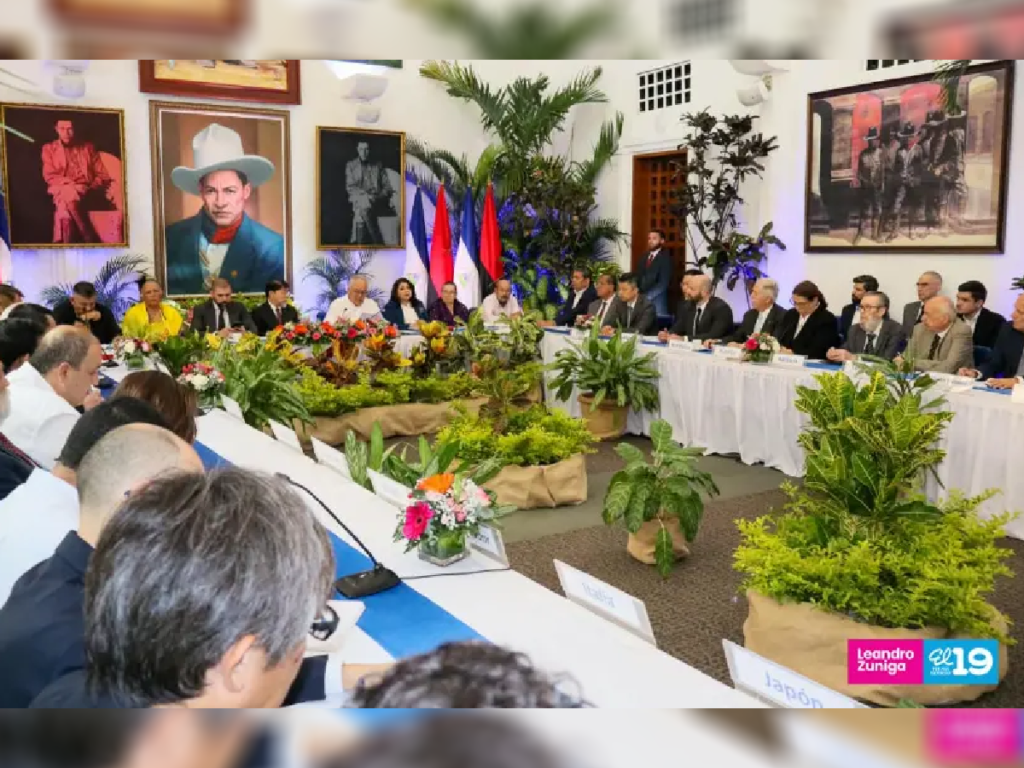
Consultation “We Have A Nation”
Meeting with Ambassadors and Heads of Accredited Missions in Nicaragua
September 25th 2026
Introduction by Compañero Denis Moncada
Co-Chancellor of Nicaragua
Good morning, esteemed Ambassadors, Heads of Mission, Representatives of International Organizations and Cooperation Agencies, thank you for your presence.
You are welcome to this Second Friendly Meeting, with the Fellow Deputies of the National Assembly, with its President Dr. Gustavo Porras.
We held the First Meeting almost 2 months ago, it was on July 27th and the Objective of this Meeting is to cordially share information on the constructive and positive development of the Popular Consultation Process, extended to all sectors of Nicaragua, on the Partial Reforms to the Political Constitution.
All this, and it is very important to reiterate this as Dr. Gustavo Porras has done, to reiterate that all this has been done within the framework of our Sovereign Institutionality. Without further introduction, and to save time, I give the floor to Compañero Doctor Gustavo Porras. Compañero, do go ahead.
Dr. Gustavo Porras
Thank you, Chancellor. Good morning to all, indeed, friends, representatives of the Diplomatic Corps, on July 27th we met in this very room, it was the day before the formal presentation of the Reform was made in the National Assembly.
On the same occasion, I am referring to July 28th at this meeting, the Assembly unanimously appointed and approved the Formation of the Special Constitutional Commission, which is what our Constitution indicates for the Process of Constitutional Reform.
To begin with, I would like to introduce you to the Members of the Special Constitutional Commission, which was not yet constituted at that time. Dr. Arling Alonso is the First Vice President of the Assembly, she is a member; likewise, our Heroine Amada Pineda, is the Second Vice President of the Assembly, she is a member; there is also the Compañero Raquel Dixon who is the First Secretary of the Assembly, of the Directive, she is a member of the Commission; Dr. Wilfredo Navarro who is the Second Secretary, he is also a member.
In addition, the 3 heads of the political groupings joined, the Head of the Sandinista Front political grouping, Dr. Edwin Castro, who is here with us; the Head of the political grouping of the Liberal Constitutionalist Party, PLC, Dr. Lester Flores, is here; and the Head of the IDB political grouping, which is the Democratic Independent political grouping joining together the PLI, ALN and APRE, three Liberal Parties that have parliamentary representation, Dr. Mario Asceniso, is here with us.
We have incorporated two presidents of the main Committees, I would say, Permanent Committees, Dr. Auxiliadora Martínez, who is the president of the Justice Committee, and Dr. Wálmaro Gutiérrez, who is the president of the Economic Commission. With us also is the Third Secretary of the National Assembly Executive Board of Directors who is also president of the Nationalist Liberal Alliance Party, Dr. Alejandro Ferreti who is over there on the corner.
We are missing someone who is not here for health reasons, who is our friend María Haydée Ozuna, President of the PLC and Third Vice-President of the Assembly; she could not come, she had surgery earlier. Well, these are the members of the Special Constitutional Commission.
From the moment we met on July 27th we proceeded, after having informed you that we were going to undertake this Reform Process, we proceeded to form the Commission, it was introduced, it was presented. It is worth explaining that the Reform was presented with 100% of the signatures of the National Assembly, of the Deputies
That is to say, all the deputies gave their support; our Constitution says that, to present a Reform Proposal, requires 30% of the signatures of the existing Deputies. In this case we present it with 100% of the signatures.
We are clear what this means, as we were also going to find the same echo in the population, because the desire for peace of the Nicaraguan people is very great, and it is expressed by their National Assembly representatives too.
So we then started the Discussion Process, as on that occasion, we had mentioned to you that there were specific points in the Reform, and now we bring you the information that the approved reforms have increased.
At that time we told you that there were 6 aspects that were going to be reformed, so now we want to inform you that in the discussion process there was an opinion that we need to increase the Reform to seven points, which is what has already been approved in the First Legislature.
It should be remembered that in our Constitution to make a Constitutional Reform, the procedure after the appointment of the Special Constitutional Commission and the presentation with the necessary number of signatures, the discussion process takes place and it must be approved on a first occasion in one Legislature and then it must be approved again in a Second Legislature, which now corresponds correspond to the following year; so that approval will correspond to us in 2027.
We reached consensus on seven points in this process; we had already explained to you the importance of these aspects, and I do want, so that we are clear, to read the seven Points that were approved, and which were ratified or modified in the Consultation Process.
The first is that our Constitution prohibits the application of extraterritorial laws promulgated by any country or group of countries, or international organizations. This is something that should not need to be said, but we believe it is a very important Principle that should be incorporated into the Political Constitution of the Republic of Nicaragua.
The Political Constitution of the Republic of Nicaragua prohibits the application of extraterritorial laws by another country, or other countries and organizations; that is, any law that is promulgated anywhere else has no legal effect on our country. And I think it’s totally right, normal.
It does not occur to us to enact laws to be executed in any other country; in the same way we do not recognize the extraterritoriality of foreign laws. That is the First Point; moreover, this was the point that was added in the Consultation Process, it was added, so it was not included on the first occasion that we made our presentation to you.
The second point is that we did say this clearly, that coup plotters, traitors to the Nation, those who ask for military intervention, those who ask for foreign interference, those who are financed with external money, or those who violate the Principles of the Constitution cannot run for public office, they cannot participate as electoral candidates nor in running for public office by appointment.
This is the approach, here we do not apply the death penalty as it exists in other countries, we did not put any of that here; straightforwardly and simply we limited ourselves to the political effects. That is to say, someone who participate in a coup attempt, someone who is a traitor to the Nation and has been tried and convicted as a traitor to the Nation; or someone who dedicates themselves to asking for invasion, foreign interference.
Such individuals cannot come and then expect to campaign to participate in a national election, which takes place under the banners of Peace.
I mean, that’s just not acceptable. That was the Second Point. Of course, I am explaining and reading it in summary, the actual article has all the legal text and the corresponding points.
The third aspect that we introduced was the period of years, at that time we were all clear that elsewhere there are different periods. Periods varied, some with 10, others 7, others 6, others 5, there are some who are 4, there are those proposing twice times 4; that is to say there is everything.
So we believe that in order to be serious we need a reasonable time for the maturation of projects, for the identification of results, for the precision of ways ahead, etc., and we have proposed and consulted the People, and the general opinion we received was that seven years be the period for electoral periods for public offices of popular election and for public offices of presidential appointment. That’s the third point.
The fourth point is that the same period be applicable out a sense of natural cohesion, applicable for the High Commands, for the Supreme Commander of the Military Forces of the National Army, and for the Heads of the Police Forces of the country. Their period will be seven years.
Then, a Fifth Point that we had mentioned on that occasion, was that the transfers, the inaugurations, the transfers of Governments, the periods should be made in Honor of our greatest universal figure in terms of Literature, but also our National Hero and great fighter expressly for Justice and also with anti-imperialist thought, Rubén Darío.
So, in honor of Rubén Darío, the inauguration will be held on January 18th, which is Rubén Darío’s birthday; Rubén Darío’s birthday is on January 18th.
In the Constitution the inauguration is currently on January 10th a week before the 18th, it seemed to us a little fair or unjust, things are either just or not. It is an injustice to ignore and not pay tribute to Rubén Darío on January 18th and we wanted to make this reparation.
The sixth point is, if we modify all these aspects that I have mentioned, the authority in charge of carrying out their operational process, the entity, the State institution is the Supreme Electoral Council, our Nicaraguan Supreme Electoral Council. Even when we review moments of our History, we learned that at one point in our history these authorities were not even Nicaraguan.
Now we do have Nicaraguan authorities able to comply with Nicaragua’s Constitution, with the Laws of Nicaragua, and with the Electoral Processes for Nicaraguans.
So this Sixth Point is that the Article dealing with the Supreme Electoral Council’s attributions is modified to give it the powers corresponding to the proposed changes, to the Electoral Reforms.
If they are going to call Elections, they are going to call the corresponding Elections every seven years; you need remember that there are three Elections in our country: The National Elections that correspond to National Authorities; the Municipal Elections that correspond to Mayors, Vice Mayors, and Members of Municipal Councils, which are one year after the National Elections. And the third Electoral Process is the Regional Elections corresponding to the Regions of the Caribbean Coast.
They also have their own dynamics in time, which is after the Municipal Ones; and it is not the following year because they are not held until March for climate-related reasons.
In other words, at any other time of the year the rains fall on the Coast and the rivers swell when we need to guarantee voter participation, so those Elections according to the Constitution are made in March from one year to the next; you might say two years later, but it’s not really two years, it’s one year and a few months.
Logic then indicates that once the seven year period has been approved, the Supreme Council has to organize, prepare the electoral calendars and everything that corresponds for each of these Elections at the appropriate time, and it has to have the Mandate and the Constitutional Strength to do so.
That is one of the things that is clear at that point, but also, when we are talking about the inscription of political parties; right now we have fourteen legally constituted political parties in the country.
These parties have to comply with all the processes, they have to put up candidates, the Supreme Electoral Council must review those Candidates, and if it finds that someone has an accusation for taking part in a coup d’état, or requesting intervention or whatever, then the Supreme Electoral Council is the authority to rule that such a candidate cannot participate. That’s true for Peter and true for Paul as our People say. This constitutional power has to be given so as to carry out that part of the Reform, it has to be given by the Constitution. That’s the Sixth point.
And the Seventh Point has to do avoiding a period with a vacuum; put another way, all the Elected Authorities, Deputies, Mayors, Vice Mayors, all the Authorities were elected for a certain period; by extending the period to seven years, it must be constitutionally established for the corresponding transitional year, that the period of elected authorities is extended to 7 years so that there is consistency.
And the elections according to the Reforms, according to the guidance of the Constitution, the next Elections will be in 2028, as the Constitution says. The only things different is that the period was extended, so they will be in November 2028, the Sunday after November 2nd which is All Saints Day, so we have to prepare everything for 2028.
And the current Authorities now in 2026 have to be extended up until the Electoral Process, so that there is no vacuum. It is an extension, in practice it is a transition. The same for the appointed Authorities; that is, there are countless Authorities, the Members of the Electoral Council, the members of the Supreme Court, so as well as these seven years applying in relation to the Elections, it will also be seven years in relation to the date of those appointments.
But anyway the periods in general in our country are going to be seven years, the periods of all these positions that have to do with political appointments. Those were the seven Points that we approved, they were approved unanimously in the First Legislature.
However, in order to reach the point where the proposal was presented approved by 100% of the Members of the Assembly, it was indeed approved with 100% of the Members of the Assembly, but you also have to know that it was also consulted with a number of our citizens that we counted at 300,000, people discussing the reforms via our model of the People President, 300,000 because we occupy a modality, which is now called hybrid; such we have an in person modality, but we also have on line connections with all the departments and municipalities.
All this was well reported, the meetings were all broadcast openly through the Assembly Channel and also through the National Channels of the media outlets across the whole country.
In fact I’d like to take a few seconds to say more about those 300,000 people, over 36 days of Consultations and among those consulted were the Military Forces of the Army, the Police Forces, the Ministry of the Interior, the Financial Sector, the Banking Sector, Investors, Entrepreneurs, Producers and Small and Medium businesses, Media Workers and Journalists, Deputies of the Central American Parliament, Municipal authorities of the People President, the Regional Governments, and Councils of the North and South Caribbean Coast, Afro-descendant Native People.
MYPYMES and Creative Innovators, the Tourism Sector and Tourism Entrepreneurs, Professors, Educators, Teachers of all Levels, Artists, Artisans and Promoters of Culture, Medical Specialists, Health Workers, State Workers, Workers of the Free Trade Zones, Workers in General.
All this is as a bloc, the Health Workers separately, then on another occasion with the Public Sector Workers with on line connections in all the country’s Departments.
We were with the Religious Sectors, Transport Operators, Traders in General, and in the end with the State entities, the Government Cabinet, the People President Public Universities and the Private Universities. The country’s Youth and Students, that was the Consultation.
Now we are in the ninth Stage, and the reform was approved in León, in the Juan José Quezada Square in León, with a very important participation showing the great representative participation of the Leonese people.
After that we gave ourselves the task of entering into a Second Stage, because we need, everyone needs to be imbued with the spirit of what this Reform process means, which is Peace, which is the highest aspiration of the Nicaraguan people, and we have seen and lived this in each of these processes; both the one we have just started and the consultations held to date.
The first legislation approval was on September 1st in greeting to the Month of our Patriotic Nation, and from then on we have now started the Second Stage of the Consultation which is territorial, direct, it is in the Municipalities.
We have already visited the Department of Estelí with its six Municipalities, and we have also finished visiting the Department of Matagalpa, with its 14 Municipalities, so we have visited 20 Municipalities, in some places the meeting is held in one municipality with the participation of the neighboring municipalities.
On another occasion we have met with two municipalities, and in some municipal capitals only the participating municipality. So we have consulted with 20 Municipalities, and 50,000 people have participated in these in person among those 20 Municipalities.
Today we start in Chinandega, today at 4 pm we will be in Chinandega; we propose to cover the department of Chinandega, today, tomorrow and the day after, with five meetings, the first will be in Chinandega itself, with the participation of Corinto and El Realejo, and so are going to cover the rest of Chinandega tomorrow as well and the day after tomorrow.
On Sunday we will be in Cinco Pinos that will include all the border towns in that area of Chinandega; which is on the border with Honduras, and in this way we are going to cover the entire country, so that people participate and also can express themselves as the People President by means of this Consultation. There are 20 Municipalities that we will cover in León and Chinandega, and we are already clear that there we have been to Estelí, La Trinidad, Pueblo Nuevo, San Nicolás, San Juan de Limay, Sébaco, San Isidro, Rancho Grande, Waslala, El Tuma La Dalia, Matagalpa, Ciudad Darío, Terrabona, Matiguás, Muy Muy, Río Blanco, San Ramón, Esquipulas and San Dionisio.
That is our aspiration, in our model, in our way of seeing things, carrying out this very important exercise of direct democracy so as to express the Sovereign decision of the Nicaraguan people.
In these meetings, we want to inform you that so far 244 Protagonists, 244 people from different sectors have participated, and you can see them on the television reports they have broadcast: Students from the Rural University, Health Workers, from each of the local municipalities have all transmitted their experiences.
Finally, I want to inform you that yesterday afternoon, September 24th we had a very important meeting, because it expresses the quality of Unity of the Nicaraguan People and the aspiration of the Nicaraguan People for Peace.
We had a meeting, with the legal representatives and the Executive Boards of the 14 legally constituted political parties in our country. All of them expressed their view, and although there are 14 parties, a total of 16 people took part, so for a couple of the parties two people spoke.
Everything was clearly expressed there, I can clearly identify three sentiments, the feeling for and the aspiration for Peace. If you look at what these processes we have mean or these changes we have made mean, they are about Peace. We don’t want people to abuse our electoral processes in order to break the Peace, it’s simple, nobody wants that, I think anyone from any country has the same aspiration.
So, that was evident among the participants, as well as the joy that with this reform’s approval in the Second Legislature, which is already clear, everyone knows that they have to prepare for their electoral participation in 2028.
Which parties were there? Alliance for the Republic, APRE; Liberal Nationalist Party, PLN; Multi-ethnic Indigenous Party, PIM; Yapti Tasba Masraka Movement, a Caribbean Coast Party. Nicaraguan Resistance Party, PRN.
Alternative for Change Party, AC; Coastal Unity Movement Party, PAMUC; Liberal Autonomous Party, PAL; Constitutionalist Liberal Party, PLC; the Progressive Indigenous Movement Party of La Moskitia, (Moskitia Pawanka) is Regional.
The Nicaraguan Liberal Alliance Party, chaired by Dr. Ferretti; Sandinista National Liberation Front, the Christian Unity Party PUC and the Independent Liberal Party, PLI.
There were 14 Parties present, and, in addition, these are the 14 Parties properly constituted in our country, that can present themselves for elections. Registering more Parties, indeed is possible, the only thing being that they have to complete all the corresponding processes, establish their Executive Boards according to the Law, and yes, according to the Constitution.
It should by no means occur to anyone to try forming a new party with outside money, with external financing or to try forming one including coup plotters and traitors to the Nation, because the Political Constitution of the Republic of Nicaragua does not allow that, nor will it be allowed.
So, we wanted to inform you about how far we have got with this, the pillars on which the reforms are built are three, as we expressed them to you on July 27th. One: Stability, this Country needs stability like all countries.
Two: Security, this country needs Security like all countries do, we’re not asking for anything special, nor are we are preparing for some eventuality or other, rather this is the normal aspiration common to all citizens around the world and all countries around the world.
Stability, security and something more which I believe unites all countries and should unite us, about this I am clear today more than ever, convinced that what unites all Nicaraguans is Peace.
Peace unites all Nicaraguans, and we have been working on the reforms with that as our guide; naturally the starting point, the clear orientation, was given to us, as I mentioned at our first meeting, by Comandante Daniel and Compañera Rosario on July 19th this year, when he said very clearly: There can be no elections here again, no elections that allow others to reverse the advances we have achieved.
And he said it clearly, elections are not going to come back leading to a breakdown in our Peace, we have to put a barrier, a containing wall so that no one can return to power so as to turn Health Care and Education into a business or to put tolls on out highways.
And that is the mandate that we have fulfilled, and that mandate, it doesn’t matter that some people have distorted it, and how they have distorted it. I remember someone asked me on one occasion, Are there going to be elections now, how are they going to be? Very clearly, there will be elections here, but they are not going to be Elections leading to a disruption of our Peace nor allowing Nicaragua’s enemies to come, take over the government take everything backwards; not any more.
Perhaps you are pressed for time, and some of you mentioned to us the issue of Educational Autonomy and what that meant, which was charging for children to go to school; or what was autonomy in the hospitals, which was to charge people for Health Care… Autonomy, in fact it was no such thing.
Here we are following a path of Peace, Prosperity and progress for all Nicaraguans, a path of Peace and Unity with all the countries of the world. That is our Principle. Now I hope to hear from all of you.
Co-Chancellor Denis Moncada
Thank you very much Doctor Gustavo Porras, for your presentation, we open the space to questions, answers, analysis, comments that the friends of the Diplomatic Corps present here have in good faith. So, your participation is open.
Ambassador Charles Mitchell
Thank you, esteemed Co-Chancellor, esteemed President of the National Assembly, esteemd Vice Presidents, esteemed Members of the National Assembly.
Thank you Doctor Porras for keeping us informed about this Constitutional Reform process via this meeting, and through us the countries of the international organizations we represent. On behalf also of the Member States of the European Union, I would like to put the following questions, if I may.
First of all, once the extensive Consultation Process that you have just described has been completed, can you share what was the impact of the Consultation on the initial Reform Proposal, and whether there will be scope to introduce modifications before the final approval, in the Second Legislature on January 18th?
The second question, I refer to the similar meeting that was offered to us in July, and in response to the question of my predecessor, Ambassador Pons, it was indicated to us that the upcoming Elections will benefit from some kind of regulation on issues of Electoral Observation, or another independent mechanism. Could you provide us with more details now? Thank you very much.
Co-Chancellor Denis Moncada
We’ll ask Dr. Porras to answer the question of the Representative of the European Union, and if there are other questions, you can ask them later. Thank you.
Dr. Gustavo Porras
As you can see, in the First Stage, we entered with Six Points of Reforms and left with Seven, as a result of that whole process of discussion and of our reality.
In this country, in the period between the first approval and the second approval, there is precedent and jurisprudence that there have been modifications in other Reforms in past such processes, and even in other moments.
We do not feel that it is necessary, we think there are no other concerns that have been raised, but that is the margin that the Law provides for and the Jurisprudence of our country presents; we will inform you in due course; that is indeed the case, but frankly we hope that everything will remain as it has currently been approved.
But just so that you know, there is jurisprudence and there are precedents when, between an approval in the First Legislature and the Second Legislature, there have been some modifications in the case of other Reforms.
That is what is laid down, and the other point is determined by Law, since the Electoral Law speaks of accompaniment which is controlled by the Supreme Electoral Council and that precisely is the term used, the word used by our Legislation, our Law.
The figure refers to someone who accompanies the Elections, someone who is present, who can arrive at the due time specified by the Supreme Electoral Council which is in charge of operationalizing these aspects.
The Doctor tells me that you raised something about the impact, I think it has to do with what we have already answered, but we were clear when we held our first meeting, today we are updating the points, and we will do so again once the whole process is finished, and we will have all the information about how this process will have evolved.
It is important, I agree with your assessment about a wide Consultation and it has indeed been a wide Consultation, a very successful one and I hope that you will follow up, because we are going to continue the process over the ensuing months until January 18th which is the date that we have proposed for approval in the Second Legislature.
Alias Aiba
Ambassador of Abkhazia
Beloved Compañeras and Compañeras, on behalf of the Government of the Republic of Abkhazia I would like to greet you, and to thank through the Ministry of Foreign Affairs, the National Assembly, and you Dr. Gustavo Porras and Deputies for organizing such events and sharing current information.
I would also like to express our support to the People and Government of the Sister Republic of Nicaragua, and stress that Abkhazia respects Nicaragua’s Right to pursue an Independent Policy, as well as Respect for the Principle of Non-Interference in the internal affairs of Independent and Sovereign countries. Thank you.
Doctor Gustavo Porras
As on the first occasion, you remember that I told you, it seems that everything is clear, but really I present this report to you from the heart. This participation of our People, of the People President, has really been very important.
You all live here, you are well aware of the aspiration of our People for Peace, Tranquility, Security, which you can verify anywhere you go in this country. So, for my part I thank you, and I hope to be here on the next occasion to inform you once more.
Co-Chancellor Denis Moncada
I would like to thank Dr. Gustavo Porras, the Compañeras and Compañeros of the National Assembly of the Special Commission on Constitutional Reforms for their presence, for their extensive presentation of important content for your information.
I thank also the participation of the Ambassador of Abkhazia, Ambassador Alias Aiba for his intervention.
To close, really, as Doctor Porras said, this is a very important meeting to continue with the information process for you, about a Consultation Process that is also very important for Nicaragua in the development of its constitutionality and its Electoral Process.
It is self-evident that, in Nicaragua, we are in a kind of innovation for the Legislative Body and that innovation is that the Legislative Body leaves its permanent, classical, historic headquarters, and communicates with the population in the territories around the country, in the municipalities, in the municipal capitals.
An exercise of Nicaraguan-style Direct Democracy, to participate, expose and consult and tell our People and the different Economic, Productive Sectors as well as those of Defense, Security, Economy, Banking, Finance, about what we plan to reform in the Constitution for the benefit of our population, for the Common Good.
That is an innovation, and insofar as I know, hardly any other country mobilizes its Legislative Power to move about in the way Nicaragua’s Legislative Body has done, in order to promote and involve the People President People in these Constitutional Reforms.
This shows an element that is also important in Nicaragua’s democracy, which is the coordination of the different governing entities in our country. In other words, there is a very close coordination between the Co-Presidents, the Legislative Branch, the Electoral Council.
It is in this practical, constructive and positive way that a real, productive, positive democracy is carried out and exercised in a country, where the dynamic of a People making their way more actively and not with the delays and trickery that can prevail in other types of exercise, where interests collide, because they are generally the interests of elite groups and not the interests of the people. That is the truth of Nicaragua’s experience and the one we are explaining to you.
But well, thanking the Compañeras and Compañeros of the Legislative Branch and also you esteemed representatives of the countries participating here, we thank you and appreciate very much your participation and we invite you, as Dr. Gustavo Porras has said, to the meetings to come, where he will continue to inform you how the Electoral Reform Process is progressing in its next phase.
Thank you very much, see you in the next sessions.
Thank you very much.