
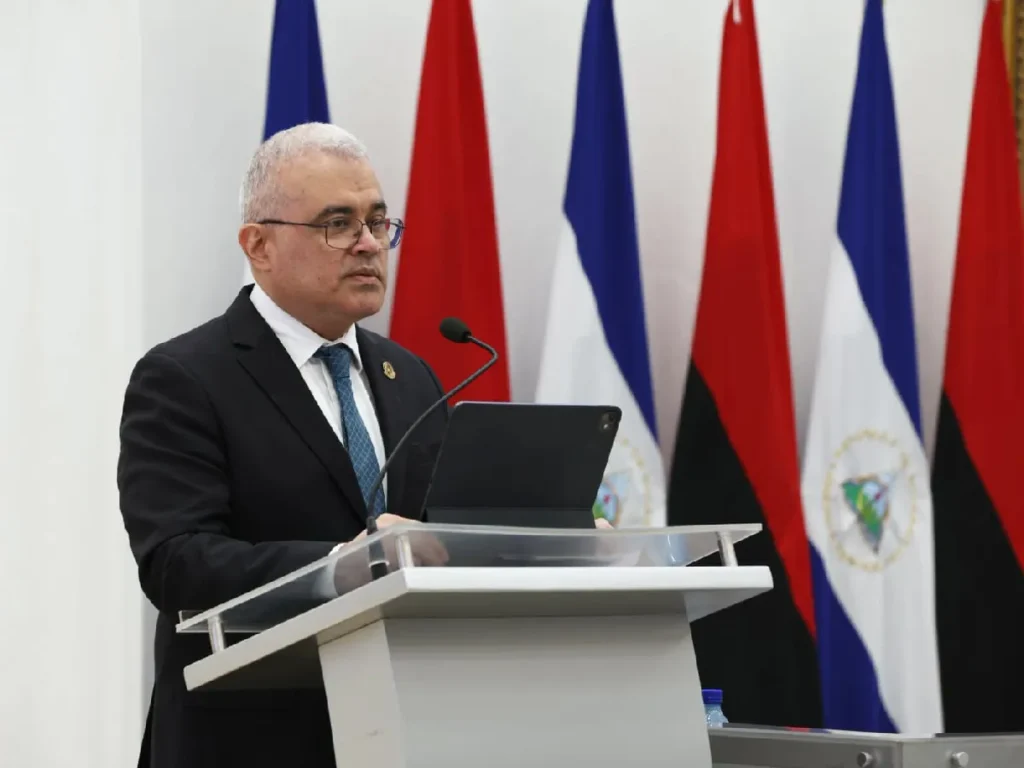
WE PRESENT THE BUDGET TO THE NATIONAL ASSEMBLY
REMARKS BY THE PRESIDENT OF THE CENTRAL BANK OF NICARAGUA, OVIDIO REYES R.
Wednesday, October 21st 2026
Dr. Gustavo Porras, President of the National Assembly
Honorable Board of Directors of the National Assembly of Nicaragua;
Esteemed Member Deputies ;
Nicaraguan families accompanying us via the media.
I. Introduction
It is an honor to appear before this Plenary at the invitation of our Co-presidents, in compliance with the provisions of the Political Constitution of the Republic in its Articles 106, 107, 125 and 132, as well as in Article 35 of Law 550, Law on Financial Administration and the Budgetary Regime. As mandated by law, on October 15th the Co-President of the Republic, Comandante Daniel Ortega, and Co-President Rosario Murillo, submitted to this National Assembly the Republic’s Annual General Budget Bill 2027, for discussion and approval.
We are presenting to this Plenary today a budget for all Nicaraguans, without distinction. The National Assembly is the house of the People, and today we are bringing here a public finance instrument, namely, the General Budget of the Republic, for the construction of a prosperous and peaceful Nicaragua. We have come here to explain how the People’s money becomes welfare for the People.
II. Macroeconomic Context and Rationale
The 2027 Budget Proposal is formulated in a complex international context. The global economy is slowing down, geopolitical conflicts have raised energy prices and inflationary pressures persist. However, Nicaragua has managed to stand firm. According to the latest indicators, economic activity grew by 4.1% in the first half of 2026, and GDP growth of around 3.7% is projected for 2027, with low and stable inflation at around 3.0% and an employment rate of 97%. We anticipate that the financial system will continue to accompany this dynamism, with growing deposits and credit. The price of oil is estimated at $97 per barrel and the stability of the official exchange rate will be maintained through 2027. Above all, we are confident in the ability of our economy to continue to insert itself into international markets with good results in exports and to maintain the dynamics of investment, both domestic and foreign. These are realistic projections, but they aim to keep revenues and public spending in moderate perspective, due to global uncertainty.
We are living in complex times in the world, but Nicaragua has managed to stand firm thanks to the peace and stability that has been built. Peace is not a public good that benefits a single sector, but the heritage of the entire nation. Without Peace there is no investment; without stability there are no projects. This budget is formulated on that basis: the unity of Nicaraguans around work, entrepreneurship, progress and peace.
III. Pillars of Budgetary Policy
The 2027 Budget is based on clear pillars. First, the fight against poverty and the reduction of inequalities as the central axis to achieve more human development. Secondly, support for investment in social and productive infrastructure, which generates employment and economic growth. Thirdly, fiscal sustainability and prudent management of public debt. Fourth, the protection of the real income of families through subsidies for electricity, pensioners, drinking water, public transport and fuels. Fifth, citizen security and national defense. And sixth, the confrontation of fiscal risks arising from climate change and natural disasters.
This budget leaves no one behind. It prioritizes the most humble, yes, but it also continues to create conditions for entrepreneurs, small and medium-sized producers, and working families to be able to find opportunities. It is a budget that invites addition and multiplication, not subtraction or division. Because the progress and development of Nicaragua is the task of everyone: in the countryside and in the city, of the public and private sectors, of youth and adults.
IV. Budget of Revenues, Expenditures and Fiscal Surplus
The main budget indicators are as follows. The 2027 General Revenue Budget amounts to 195,136.7 million córdobas, which represents an increase of 23,435.1 million, that is, 13.6% more compared to the approved budget for 2026. Its main source is tax revenues, which total 183,495.8 million córdobas, representing 94.0% of the total. As a proportion of GDP, total income reaches 20.6%.
The 2027 General Expenditure Budget amounts to 168,238.0 million córdobas, that is, C$1,459.1 million increase over the approved budget for 2026, of which 114,286.0 million correspond to current expenditure and 53,952.0 million to capital expenditure. As a proportion of GDP, total expenditures reach 17.7%
As a result of a budget of revenues being greater than that of expenditures, this generates an overall budget surplus of 26,898.7 million córdobas, equivalent to 2.8% of GDP. With this, we have come to accumulate seven consecutive years of surplus fiscal accounts.
The higher revenues and expenses, as well as the higher budget surplus, are not cold numbers: they are the expression of responsible and future-oriented public management. As in a family, when income exceeds expenses, the door opens to savings and, therefore, to investment. Public savings have made it possible to reduce the public debt from 68% to 48% of GDP, without sacrificing public investment spending, which instead has increased in recent years. Today we can say firmly that we have begun financing our public works with our own resources, which before were mainly carried out with external cooperation. This generates confidence and is the basis for continuing to implement productive projects.
V. Spending Priorities: Health, Education and Infrastructure
Going into the details of the Expenditure Budget, the main institutions that receive resources are the Ministry of Health, with 33,023.3 million córdobas, equivalent to 19% of the total expenditure; the Ministry of Education, with 20,248.4 million, 12% of the expenditure; the Ministry of Transport and Infrastructure, with 16,480.9 million, 9% of the expenditure; municipal Transfers, with 12,844.7 million, 7%; and Universities and Higher Technical Education Centers, with 10,215.2 million, 6%. As a whole, these items account for almost half of the total expenditure.
The 2027 Public Investment Program amounts to 51,423.7 million córdobas, equivalent to 5.4% of GDP. It is important to note that 81% of this investment is financed with domestic resources, which is a great strength and reflects what we have been highlighting, financial sovereignty, ability to undertake projects with national resources, moving away from conditionalities and debt.
Among the emblematic projects, the reconstruction and expansion of the Punta Huete International Airport stand out, with 4,283.9 million córdobas; the construction of the Port of Bluefields, with 3,325.4 million; the Road Surfacing Program, with 1,968.3 million; and the Rehabilitation of Inter-municipal Roads, with 1,198.7 million. In addition, the rehabilitation of the Juan Pablo II urban Highway and the construction of overpasses in Managua continue, with 1,953.2 million.
In the health sector, the construction and equipment of the “Lesbia Carrasquilla” Eastern Hospital in Managua stands out, with 1,513.8 million córdobas; the Afro and Native People President Hospital in Bluefields, with 1,496.8 million córdobas; the “Dr. Carlos Vanzetti” National Neurosurgery Center with 1,101.9 million; and the “Dr. Juan Ignacio Gutiérrez Sacasa” National Oncology Center with 656.0 million córdobas.
There is also room to continue promoting sports. Resources are being allocated for the National Dignity football stadium, with 398.6 million córdobas; the Stanley Cayasso Baseball stadium, with 250.0 million córdobas; the baseball stadium in Bluefields, with 221.9 million córdobas; the football stadium in Ocotal, with 201.4 million córdobas, and a similar amount for the football stadium in Jalapa, as well as other stadiums.
There are no façade works or empty promises here. These are hospitals that are being built, schools that are being filled with children, roads that connect communities and bring families closer. Each Córdoba of this budget is designed to improve people’s daily lives, so that a mother can take her child to the doctor and receive free assistance, so that a young person can study and not have to pay for those studies, so that a producer can get in their harvest easily and with lower costs.
VI. Social Spending and the Fight against Poverty
Since the budget’s priority is poverty reduction, spending on programs and projects to combat poverty reaches 108,849.9 million córdobas, which represents 64.7% of total spending and is equivalent to 11.5% of GDP. This means that out of every 100 córdobas that are raised, almost 65 go directly to those who need it most. Likewise, social spending amounts to 96,486.1 million córdobas, equivalent to 57.4% of total spending and 10.2% of GDP. The health and education sectors absorb 64,417.4 million córdobas, that is, 66.8% of social spending.
In addition, subsidies aimed at protecting the real income of the most vulnerable families are maintained: the subsidy for collective urban transport in Managua and Ciudad Sandino, the subsidy for transport at the national level, the subsidy for the consumption of electricity and drinking water for pensioners, and the subsidy for the price of fuel, which has allowed maintaining the stability of domestic prices in an adverse international context.
In essence, this is a budget for human development, a key feature of the Government model. It is about organizing public spending so that everyone has access to the services that the State provides, to work and live with dignity. That is the mandate of Co-Presidents Daniel and Rosario, to ensure that public resources are used clearly and efficiently, for the benefit of all.
VII. Conclusion
Honourable Member Deputies:
The 2027 General Budget of the Republic Bill which is being presented for your consideration consists of 21 articles that continue to create the bases for the development of Nicaragua. You have in your hands the approval of a budget that sows progress and hope. Because in the end, this is what we all want: a peaceful, prosperous, solidarity based, developing Nicaragua.
We hope, then, that the 2027 budget will be favorably approved and ratified by all the Deputies, because it is a budget of the People and for the People.
Thank you very much.